Trees on the Yale Nature Walk

Tree ID: 106
Date of tree entry: February 5, 2020
Myrica pensylvanica is an upright semi-evergreen shrub that often spreads by suckers to form colonies. Northern Bayberry is noted for its ornamental silver berries in winter, its winter salt spray tolerance, and its adaptability to urban stresses or wet sites, making it a perfect asset to a centralized location on Yale's campus.
Tree ID: 118
Date of tree entry: February 4, 2020
Tree ID: 116
Date of tree entry: February 4, 2020
Tree ID: 119
Date of tree entry: February 4, 2020
Tree ID: 115
Date of tree entry: February 4, 2020
Tree ID: 99
Date of tree entry: February 7, 2019
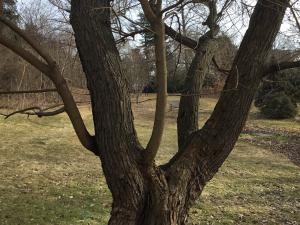
This tree is on the slope leading to Marsh Botannical Gardens. It leans downhill and gives a delicate impression with one short trunk and seven thinner trunks branching off. It has a scaly bark and blooms in June. While most American smoketrees have short trunks, this tree has an especially short trunk because it was hit by a neighboring redwood as a young tree. This fall split the trunk into eight small branches. One was shaved off in March, so now there are seven branches coming out of the trunk and its diameter at breast height is smaller.
Tree ID: 98
Date of tree entry: February 7, 2019
The Seven Son Flower comes from the mountains of Central China, where it received its name for the flowers that come in clusters of seven. A cousin of the honeysuckle, this small tree is known for its colorful bark and beautiful white flowers that bloom in early fall.
Tree ID: 101
Date of tree entry: February 7, 2019
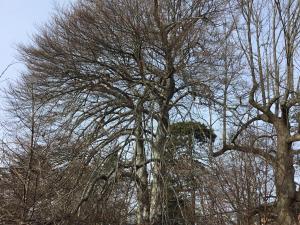
Hidden among the foliage near Marsh Botanical Gardens, this tree is hard to come across. In order to access this tree, one must have climbed through slushy mud or a sea of beautiful angiosperms, depending on the season. This tree is fairly large, standing at nearly twenty four meters tall. Aside from its height, this tree's most distinctive features include its unique branching and rough bark.
Tree ID: 100
Date of tree entry: February 7, 2019
Larix laricina, commonly referred to as the tamarack or American larch (USDA symbol LALA), is a slender, conical-shaped tree belonging to the Pinaceae (Pine) family that grows 40 to 80 feet tall. The larch species is the only known deciduous conifers aside from the bald cypress. Just like other deciduous trees, their tufts of glossy needles (typically a bright green) turn golden-yellow and fall off in autumn. The tamarack’s deciduousness makes it practically immune to the road salt that is frequently laid down during winters.
White oak in the fall
Tree ID: 93
Date of tree entry: February 6, 2019
Sprawling, beautiful tree outside of the Bett's house. It is the largest tree to the left of the house on the lawn. If you look closely, you'll see old etchings from lovers long ago.

Pages