Trees on the Yale Nature Walk

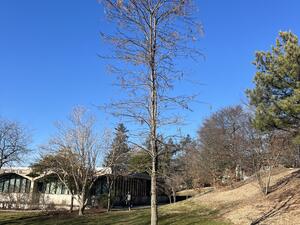
Picture of entire sawtooth oak
Tree ID: 174
Date of tree entry: February 7, 2024
This sawtooth oak is found near the bottom of the hill by the Marsh Botanical Gardens. It has a relatively thick trunk and is flanked by two smaller trees.
Tree ID: 165
Date of tree entry: February 7, 2024
The Limber Pine, of the family Pinaceae and the genus Pinus, is an evergreen gymnosperm native to the Rocky Mountains of Western U.S. and Canada. Limber pines range from 7-12 m in height and 60-90 cm in diameter; they have needle-shaped, dark-green leaves, light-gray bark that becomes red-brown with age, and resinous, flexible branches. They thrive in subalpine habitats (10,000 to 11,500 feet in elevation), but are remarkably adaptable due to their tolerance to cold and drought. They are monoecious, with clustered yellow-brown staminate cones and woody, deep-brown ovulate cones that give rise to winged seeds. The seeds (pine nuts) and inner bark of Limber Pines are food sources for various animals, most notably nutcrackers and squirrels, who in turn aid in seed distribution. The branches of the Limber Pines also serve as a habitat for various animals and rodents, providing protection from predators and adverse weather conditions. Limber Pines can take several hundred years to reach maturity and can live for over 1000 years. Though Limber Pines are evergreen, fertilization of ovulate cones only occurs in late spring, and seed dispersal mainly occurs in the fall. Though Limber Pine wood is not suitable for commercial timber harvesting, its timber has been used for cabins, fencing, mining, and firewood. Limber Pines bear pine nuts, which have a wide variety of culinary applications in foods like pesto, salads, granola, and various baked goods. Not factoring in human activity, the greatest risk to Limber Pine populations is disease: both white pine blister rust (a common fungal disease in pines) and dwarf mistletoe (Arceuthobium Cyanocarpum) are leading causes of Limber Pine mortality.
Tree ID: 159
Date of tree entry: February 7, 2024
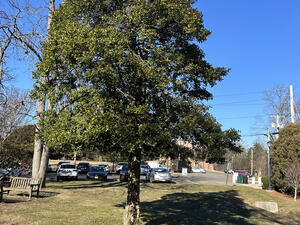
This Scots Pine is located in the Marsh Botanical Gardens. In late winter, it has sparse leaves, many pine cones, and laterally extending branches. In spring, it has more cones, sap, and its needles look slightly more green. It is near the street side of the gardens, and has some broken branches. Its bark is red/brown, and this tree grows best in slightly acidic pHs, close to neutral pH.
Tree ID: 156
Date of tree entry: February 7, 2024
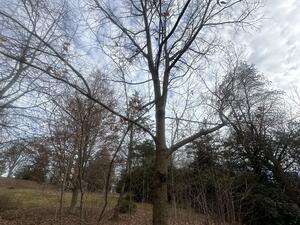
Also known as the blackgum, the black tupelo is a slow-growing deciduous tree known for its vibrant autumn leaves and highly-sought after honey. Black tupelos are successful at attracting pollinators like bees to their flowers and birds and small mammals to their fruits. Black tupelos are native to Connecticut and can be found anywhere from southern Ontario to Mexico.
Tree ID: 169
Date of tree entry: February 7, 2024
Tree ID: 167
Date of tree entry: February 7, 2024
This Eastern White Cedar is planted right in front of Marsh Hall along the path to the front door of the building. Surveyors have declared that this tree's name is Holly. It is near a few other trees and flowers, though surveyors agree that Holly is the best plant among them because she is a majestic cedar tree with a cone shape and evergreen foliage.
Tree ID: 173
Date of tree entry: February 7, 2024
Metasequoia glyptostroboides is a coniferous tree native to the Sichuan-Hubei region of south-central China. It was thought to have been extinct for millions of years; in fact, even until the early 1940s, Metasequoia glyptostroboides was only known by fossil record. In 1946, a group of botanists in China discovered a living specimen in the western Hubei province. The discovery of this "living fossil" made international headlines, and ever since, dawn redwood—as it is referred to colloquially—has been the embodying symbol of conservation .
Tree ID: 164
Date of tree entry: February 6, 2024
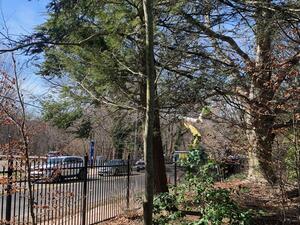
Meet the majestic Cedar of Lebanon, a true highlander of the tree world, that stands between 1,300 and 3,000 meters in elevation and can grow to be 40-60 feet tall! Known for its resilience, this true cedar has been a builder of empires and a symbol of strength for many countries. It's not just a tree; it's a historical pillar that has sailed through ancient Egyptian myths, fortified sacred temples, and even snagged a starring role on Lebanon’s flag. If trees were celebrities, the Cedar of Lebanon would be the timeless icon everyone wants at their garden parties!
The picture displays a red pine tree in the Marsh Botanical Garden.
Tree ID: 158
Date of tree entry: February 6, 2024
Red pine, also known as Norway pine or eastern red pine, is an evergreen conifer tree with a conical shape and a straight trunk. It is native to northeastern United States and parts of Canada, and it can be found from Newfoundland and Manitoba, all the way south to Pennsylvania, and west as far as Minnesota. It typically reaches heights of 50 to 80 feet, with some specimens growing up to 125 feet tall, though our specimen seems to be a baby at only around 12 feet so far. The bark of red pine is reddish-brown, giving the tree its name, and its needles are green, slender, and grow in bundles of two. The tree produces ovoid seed cones that have a beautiful scent! Enjoy this beautiful tree in every season and watch it grow throughout the years!
Tree ID: 150
Date of tree entry: February 6, 2024
Located in the south-east corner of the Marsh Botanical Gardens, standing tall over a bed of its fallen needles. The Eastern White Pine is the official tree of Maine and Michigan! Try pinching off a small amount of the trees resin, it smells fantastic.

Pages