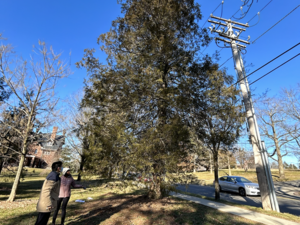
Trees on the Yale Nature Walk

The Chinese Dogwood (Cornus kousa)
Tree ID: 146
Date of tree entry: February 6, 2024
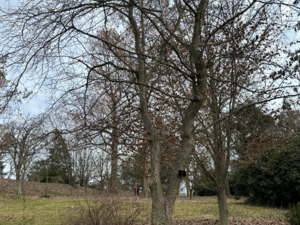
The Chinese Dogwood Tree, or Cornus kousa, is a small to medium tree originally native to East Asia. It was originally introduced to North America in the 19th century. It blooms in late April to early May. Kousa berries are soft, sweet, and edible, with a flavor that is similar to that of a persimmon. However, the seeds are attached to the pulp, making them difficult to be eaten directly. The berries have a hard rind, which is often discarded due to its bitter taste; however, the rind is also edible. The kousa is believed to have transmitted a deadly fungus to native dogwoods in the late 1900s. This anthracnose fungus started to destroy native dogwoods in the U.S. (Cornus florida). At the time, the kousa was not considered invasive, as the fruits of the kousa did not appeal to wildlife in America. Its fruit was the original food for monkeys in East Asia. The kousa population was subsequently planted in the U.S to help mediate the loss of native dogwoods, as botanists thought the population could be controlled and regulated (thinking it could not become an invasive species due to the lack of the necessary wildlife required to spread seeds and eat its fruit). In recent years, the kousa has evolved to no longer rely on monkeys to spread and reproduce. Today, the kousa is now considered invasive in the state of New Jersey, as some researchers at the University of Massachusetts Amherst believe there is often a lag between when a species is introduced and the time it takes to be invasive. The kousa was previously hailed as a substitute for the dying native dogwood population, but today, it poses a threat and is another invasive species. This particular Cornus kousa tree was approximately 5.55 m and had three large branches that branched right from the bottom. It had many different branches coming off it and a DBH of approximately 23.7 cm. As of April 22nd, 2024, it has begun to bud; however, it has not fully bloomed yet. We can expect the tree to bloom in the Marsh Botanical Gardens in the coming weeks.
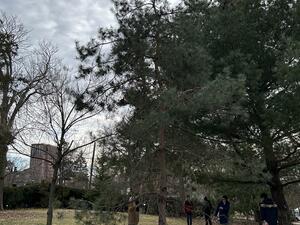
Tree ID: 152
Date of tree entry: February 6, 2024
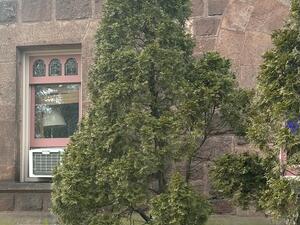
This tree is a Sawara Cypress, also known as a False Cypress, located in the Marsh Botanical Gardens. It is a gymnosperm with small, globose cones and green, scaly leaves (indicating that is an adult tree), which are typically between 1/8 and 1/4 inches long. The tree shape is irregular, and its bark exhibited the characteristic peeling quality, being light brown and revealing red strips underneath. There also appeared to be some plant matter growing on the street-facing side of the trunk. Native to Japan, the Sawara Cypress can grow to be between 8 and 37 m in height. Alongside the Hiba Cypress (Thujopsis dolabrata), Hinoki Cypress (Chamaecyparis obtusa), Koyamaki (Sciadopitys verticillata, also called the Japanese Umbrella Pine), and Nezuko Cypress (Thuja standishii), the Sawara Cypress is one of the five prized trees of the Kiso Region.
Tree ID: 180
Date of tree entry: April 27, 2023
The paperbark maple is one of the most beautiful of the maple family. Native to central China, this deciduous tree slowly grows up to 9 meters tall and 6 meters wide, with the trunk's circumference reaching 28 cm. The branches, which grow low to the ground, don trifoliate leaves, and the trunk is composed of orange to bronze papery bark that peels back on the trunk over time. The maple prefers full sun and moist soil for growth but will settle for partial shade as well. Though once common in central China, deforestation and lack of conservation has made it an endangered species in its native land, while it has become a popular ornamental tree around the United States.
Tree ID: 157
Date of tree entry: February 13, 2023
The Cotoneaster dammeric is a species of flowering plant native to central and southern China. This shrub is a vigorous, dense, evergreen shrub with elliptic-oblong leaves. This plant blooms small white flowers in May, followed by red berries. At Yale, the Bearberry shrub is located throughout the Pauli Muarry and Benjamin Franklin walkway. The shrub is low growing and expansive covering much of the peripheral walk-way.
A black locust near SCL
Tree ID: 178
Date of tree entry: February 9, 2023
This tree has five individual structures, each reaching about the same height. Standing across from SCL, the tree frames 230 Prospect street and offers shade to those leaving the parking complex behind the Yale Interdisciplinary Center for Bioethics. A squirrel has been spotted on this tree and the surveyors are hoping it makes another appearance for their presentation.
Tree ID: 175
Date of tree entry: February 9, 2023
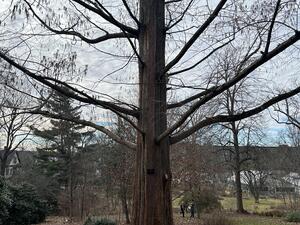
Tall, drooping branches. The twigs are pale gray and the bark is brown. As a deciduous tree, the Green Ash loses its leaves during the colder seasons. Once the weather became warmer, we were able to observe the Green Ash’s green leaflets and buds that grow opposite from one another. Its leaves have pointed tips and tapered bases, colored medium to dark green during the warmer weather. Its bark ridges are diamond shaped. We also were able to see some small green, or purplish flowers blooming.
Tree ID: 154
Date of tree entry: February 8, 2023
Sweetbay magnolias are late-blooming trees that are native to the Eastern United States. They are deciduous trees that produce flowers and fruit. They also have a moderate salt tolerance, as well as fire resistance. Its high water tolerance does well in swampy, boggy habitats or near streams. They are usually around 10-30 feet tall, on some occasions, they can be 60 feet tall or, in Florida, 90 feet tall.
Tree ID: 166
Date of tree entry: February 8, 2023
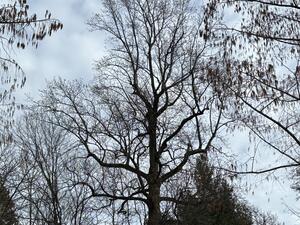
The Kentucky Coffeetree is a slow to medium-growing species that is native to the midwest; it was Kentucky's state tree for nearly 20 years, hence providing the first part of this organism's name. While the second part of this tree's name (coffee) may seem inviting to taste this plant, it is important not to eat this plant raw, as the seeds and pods are poisonous to humans because they contain cytosine. However, upon roasting them, one can use the leaves, seeds, and pulp of the Kentucky Coffeetree to make beverages similar to coffee. This tree is remarkable in its toughness and adaptability; it can survive both droughts and floods, as well as high levels of air pollution. The Kentucky Coffeetree makes a great ornamental tree (as seen on Yale's campus) due to its unique ascending branching structure, which gives the plant a crown-like appearance. Students can look forward to this striking view as May and June approach, as the Kentucky Coffeetree is known to bloom in late spring. On the topic of blooming, this species is deciduous; its leaves emerge in a beautiful bronze-pink shade and progress to dark green over time, then as fall comes, the leaves turn yellow and brown before falling from the tree.
Tree ID: 172
Date of tree entry: February 8, 2023
Hamamelis virginiana, most commonly known as the American witch-hazel, grows as a small deciduous shrub or tree. Though the species name "virginiana" means "from Virginia," the American witch-hazel is native to the broader region of eastern North America. Multiple branches extend from its base, typically growing about 15 feet tall. The plant is in peak bloom from late October to early November. Its characteristic bright yellow flowers have four thin petals and a calyx that darkens to a red color throughout the flower's development. The American witch hazel also produces fruit that appear as capsules. Witch-hazel has important medicinal uses as it is one of the only plants FDA approved for non-prescription use [1].
Tree ID: 153
Date of tree entry: February 8, 2023
The Eastern Redbud tree, also known as Cercis canadensis, is a small, deciduous tree that can be found in eastern North America. It is commonly found in wooded areas, along streams, and in parks and gardens. The tree grows to be 20-30 feet tall and has a rounded, spreading canopy that provides dappled shade. Its bark is dark brown and slightly rough, and its heart-shaped leaves are bright green in the spring and summer, turning yellow in the fall. One of the Eastern Redbud's most striking features is its pink to purple flowers, which appear in early spring before the leaves. These small, pea-like flowers bloom in clusters along the branches, making the tree look as though it is covered in pink or purple mist. After the flowers fade, the tree produces flat, brown seed pods that persist into the winter. The Eastern Redbud's wood is hard and dense, making it useful for woodworking projects. The tree is relatively low maintenance and can tolerate a wide range of soil types, as long as they are well-draining. It is also resistant to pests and diseases. Overall, the Eastern Redbud is a beautiful and versatile tree that adds color and interest to any landscape.

Pages