Trees on the Yale Nature Walk

Tree ID: 170
Date of tree entry: February 8, 2023
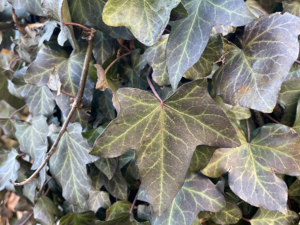
A message from our English ivy specimen growing up a wall and neighboring tree along the Farmington Canal Trail behind Pauli Murray: "Ivy is one of those plants everyone knows, and comes with a lot of baggage..." well excuse me, don't we all?! I may be getting dragged on the daily for "dominating the canopy," "invading California and the northwestern United States," having fruits that are "toxic to humans and livestock," or being "very costly and labor intensive to eradicate," but the haters only make me stronger. And I didn't hear a peep from them when I was out here purifying their air, making the front of their house all green and trendy, or providing shelter for adorable birds and bats. Long story short, it's tough being famous. I came here all the way from Europe and Africa, so love me or hate me...plant me or spend thousands of dollars and countless Saturdays trying to remove me...I'm not going anywhere anytime soon. ;) With love and ground cover from your favorite woody, perennial vine, English Ivy P.S. Please do not group me together with my sister Poison. We don't know where she went wrong...
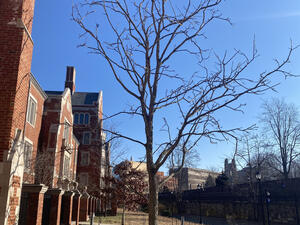
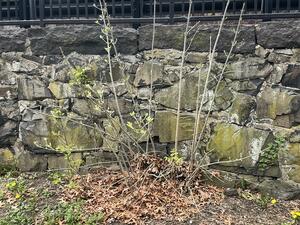
Young white ash (4/25/23)
Tree ID: 171
Date of tree entry: February 8, 2023
The White Ash tree is native to eastern and central North America and is home to many different wildlife species, including birds, squirrels, and insects.
Tree ID: 168
Date of tree entry: February 8, 2023
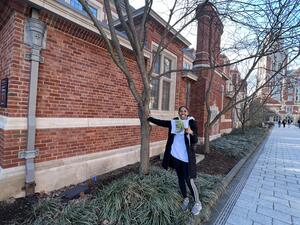
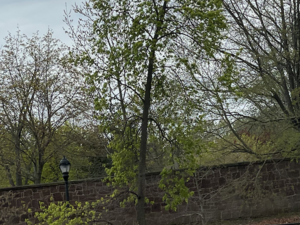
This tree is commonly known as the Sugar Maple and belongs to the Sapindaceae family. It is situated on a bed of ivy near Prospect street. One defining characteristic of this particular tree is the way it is slanted. It has a very prominent curvature and it started growing leaves in the beginning of April.
Tree ID: 155
Date of tree entry: February 8, 2023
Tree ID: 160
Date of tree entry: February 8, 2023
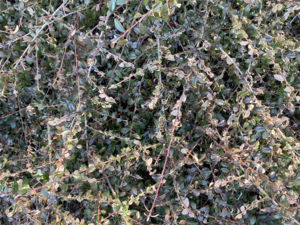
Nestled within Yale's campus, an understated beauty awaits discovery: Appalachian Tea, scientifically known as Ilex glabra. Also called Inkberry or Evergreen Winterberry, this unassuming shrub is a native of the eastern United States, with its natural habitat extending from the Appalachian region to the coastal plains. Despite its unassuming appearance, Appalachian Tea holds a world of fascination within its glossy leaves and dark, lustrous berries. From its historical use by Native American tribes for medicinal and ceremonial purposes, to its ecological importance in supporting wildlife, to its potential as a landscaping plant, Appalachian Tea has a rich story to tell. Embark with us on a journey of exploration as we unveil the captivating secrets of this lesser-known yet extraordinary plant that graces the Appalachian landscape with its unique charm.
Tree ID: 151
Date of tree entry: February 7, 2023
This tree is a cultivar of the Eastern White Pine which means it was cultivated especially for decorative use.
Tree ID: 147
Date of tree entry: February 7, 2023
The Quercus alba tree (also known as Eastern White Oak) has a spreading tree shape. It is native to primarily Eastern North America (some Central NA) and can be found all the way from Quebec, Canada to the northern parts of Florida, U.S (USDA, n.d.). The Q. alba tree usually grows to be about 24-30m tall with a DBH of 0.9-1.2m (USDA Forest Service, n.d.). Fun fact: the Q. alba tree has medicinal properties, and can be used to treat diarrhea (Foster & Duke, 2014).
Tree ID: 134
Date of tree entry: February 23, 2022
Acer saccharum, the Sugar Maple tree is native to the hardwood forests of Eastern Canada and the Northern United States, best known for being the primary source of maple syrup and for its brightly colored fall foliage. Sugar Maples are deciduous tress which normally reach heights of 25-35 m and can even grow up to 45 m. They have deciduous palmate leaves whose color changes year round between green, yellow, orange, red, brown, and colors in between. Their fruit are pairs of samaras, which are colloquially known as "twirly birds" because as they fall from the tree, the twirl around until they reach the ground. Fun Fact: One of the students whose tree this is used to have a sugar maple in her front yard as she is from Wisconsin. The sugar maple is actually the state tree of Wisconsin (in addition to New York, Vermont, and West Virginia).
Black Chokeberry in the Winter
Tree ID: 131
Date of tree entry: February 16, 2022
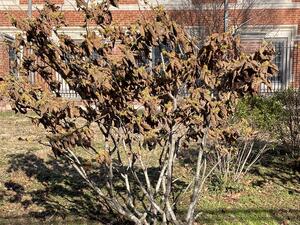
The black chokeberry is a species of shrub that is characterized by its black berries and glossy green leaves. During the spring, the shrub begins to grow white-colored flowers and at the beginning of autumn, it begins to grow clumps of black-colored berries. However, during the winter months, the shrub sheds its leaves and only leaves behind the berries, which can begin to whither due to the cold environment. These berries are edible and serve as a food source for local animals, such as birds.
Tree ID: 142
Date of tree entry: February 17, 2022
Waist-high rose bush situated next to Benjamin Franklin College bike path, and across from Yale Health and Grove St Cemetery. In spring, the plant has red flowers and light green leaves; its branches are mottled crimson and brown and are visible in the winter, when the shrub lacks leaves and flowers. Rosa Chinensis is native to south-west China and can grow up to 1 to 2m tall with single, semi-double or double flowers with red, white, pink or purple petals–it can grow in hedges or form thickets. China roses were cultivated in their native lands before the Europeans discovered them. Their floral scent is one of the ways that they lure insects to pollinate and who receive pollen or nectar as a reward–their scent is a particularly important pollinating syndrome when there are poor visual cues for pollinators.

Pages